
Key Takeaways:
- Six colds a year is above average, but not extreme. It roughly doubles the CDC’s upper estimate (2–3) and sits about 1.5x above WebMD’s upper estimate (2–4), placing it on the high end of normal rather than clearly abnormal.
- “Average” is a range, not a fixed number. Even two credible 2026 sources land on slightly different adult estimates, which shows there’s no single correct benchmark for how often someone should get sick.
- Kids get sick far more than adults. Estimates range from roughly six to twelve colds a year for children, especially those in school or daycare settings with heavy exposure to other kids.
- Exposure is one of the biggest drivers of frequency. Teachers, parents of young children, healthcare workers, and frequent travelers are naturally exposed to more viruses, which raises their odds of getting sick more often.
- Lifestyle factors matter as much as raw numbers. Sleep quality, chronic stress, household size, and underlying health conditions all influence where someone falls within the “normal” range.
- Frequency alone isn’t usually a red flag. Neither source treats going a couple of illnesses above average as inherently dangerous — what matters more is whether illnesses are unusually severe, long-lasting, or recurring in the same way each time.
- Simple habits can shift your position within the range. Handwashing, consistent sleep, stress management, and staying current on vaccinations are the most consistently cited ways to reduce how often you get sick, even if colds can’t be eliminated entirely.
You wake up with a scratchy throat for what feels like the fifth or sixth time this year, and the same question pops into your head every time: is this normal, or is something actually wrong with your immune system? It is one of the most searched health questions out there, and for good reason. Nobody wants to feel like they are constantly fighting off a cold while everyone around them seems fine. The good news is that there is real data on this, and once you look at it closely, six colds a year is not the mystery it might seem like. Let’s dig into what two major 2026 health sources actually say about how often people get sick, and what that means for you.
What the Research Actually Says About How Often You Get Sick
Before jumping to conclusions about a weak immune system, it helps to know what “average” even looks like. Health researchers have been tracking cold and respiratory illness frequency for decades, and the numbers tend to cluster in a fairly predictable range for adults, with a much wider spread for kids. The tricky part is that “average” does not mean “universal.” A statistic that says adults typically catch two to three colds a year is describing a bell curve, not a hard ceiling. Some people fall well below that number, and plenty of people fall well above it, especially depending on their age, lifestyle, and how much time they spend around other people who are sick.
That is exactly why looking at more than one dataset matters. A single number from a single source can make it seem like there is one correct answer, when in reality health agencies and medical publishers each pull from slightly different populations, timeframes, and methodologies. Comparing two credible 2026 sources side by side gives a much more honest picture of where six sicknesses a year actually falls.
Breaking Down the CDC’s 2026 Numbers

The Centers for Disease Control and Prevention’s common cold guidance was updated in early 2026, and the figures are pretty straightforward. According to the agency, adults in the United States typically come down with a cold two to three times per year, while children tend to get sick more frequently than that. The CDC also points out that colds are a leading cause of missed school and work days, which underscores just how disruptive even a “normal” number of illnesses can be to daily life.
A few things stand out when you look closely at this guidance:
- The CDC frames colds as an upper respiratory infection that can be triggered by more than 200 different viruses, which helps explain why some years feel worse than others depending on which strains are circulating.
- Symptoms are described as typically peaking within two to three days, with most colds resolving in less than a week, so frequency and severity are treated as two separate issues.
- The agency does not draw a hard line for what counts as “too many” colds, which suggests that going above the typical range is not automatically treated as abnormal from a clinical standpoint.
What this tells us is that the CDC’s benchmark is really a midpoint, not a cap. If an adult reports getting sick six times in a year, that is roughly double the commonly cited average, but it is not framed anywhere in the agency’s guidance as inherently dangerous or unusual on its own.
What WebMD’s 2026 Data Adds to the Picture
The second data point worth examining comes from WebMD’s common cold overview, published in the spring of 2026. This source estimates that people in the United States collectively experience around one billion colds every year, which gives a sense of just how common these illnesses are at a population level. More specifically for our purposes, WebMD’s figures put children at roughly six to ten colds annually, a noticeably higher range than the CDC’s general adult estimate. The same source notes that kids in households with school-aged siblings can rack up as many as twelve colds in a single year because of how easily viruses move through classrooms and daycare settings.
For adults, WebMD lands in a slightly wider band than the CDC, citing an average of about two to four colds per year, while acknowledging that the actual range varies quite a bit from person to person. That subtle difference between “two to three” and “two to four” might look small, but it matters. It shows that even trusted medical publishers do not converge on one exact number, and it widens the realistic “normal” range for adults up toward four illnesses annually before you are even considered an outlier.
Put the two sources next to each other and a pattern emerges:
- Both agree that colds are extremely common and that frequency naturally varies by age group.
- Both agree that children get sick more often than adults, largely due to close contact in schools and daycare environments.
- The specific adult range differs slightly (two to three versus two to four), which shows that “average” is really more of an estimated band than a fixed target.
- Neither source suggests that exceeding the average by a couple of illnesses automatically signals an underlying health problem.
So Is Six Colds a Year Actually Normal?
Here is where the two datasets become genuinely useful instead of just interesting trivia. If the CDC puts typical adult frequency at two to three colds annually and WebMD extends that up to two to four, then six illnesses in a year is above both ranges, but not wildly so. It sits at roughly double the CDC’s upper estimate and about 1.5 times WebMD’s upper estimate.
For context, that gap is smaller than the difference between the low end and high end of the childhood ranges cited by both sources, where kids can reasonably experience anywhere from four to twelve colds a year depending on their environment. In other words, six sicknesses a year for an adult is elevated compared to the typical benchmark, but it is not so far outside the data that it should automatically be treated as a red flag. It is more accurately described as being on the high end of a wide, normal human range, especially if you work in a school, have young kids at home, travel frequently, or live in a household with several other people.
Why Some People Get Sick More Than Others
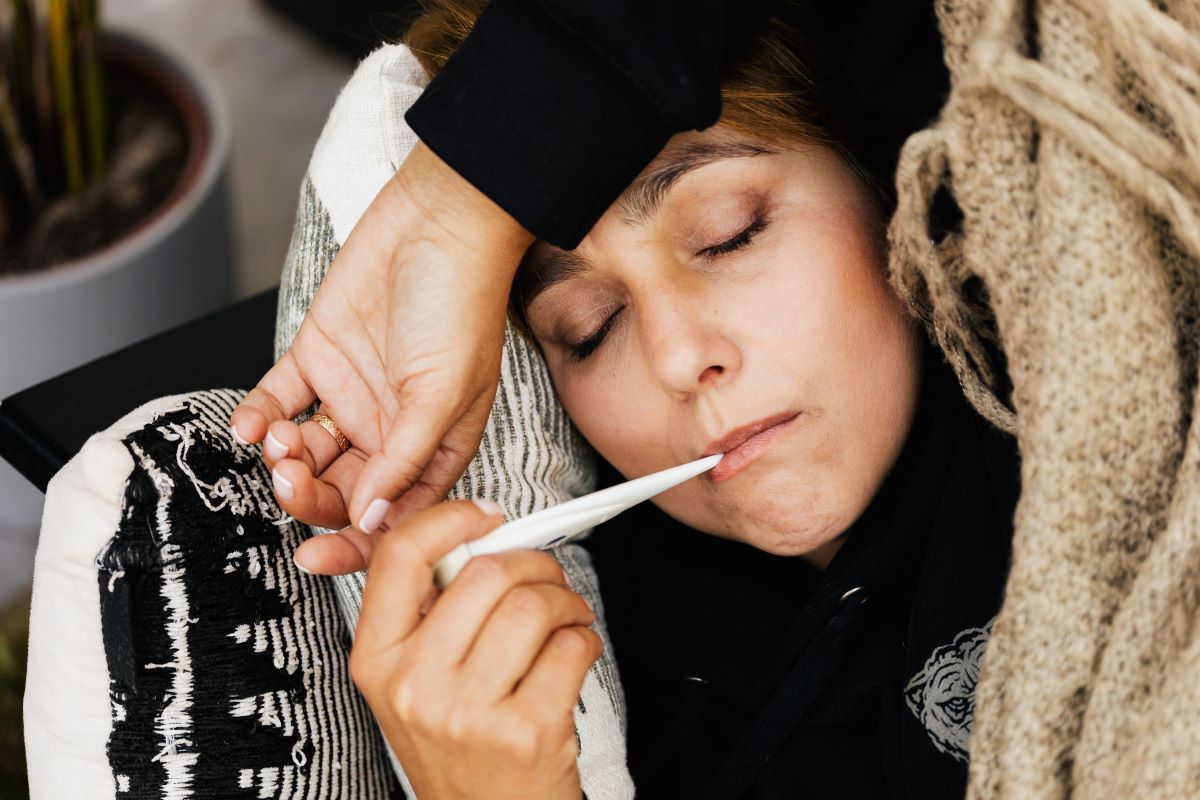
Averages are useful, but they flatten out a lot of individual variation. A few factors consistently show up in health research as reasons someone might land well above the typical range:
- Exposure levels: Teachers, healthcare workers, parents of young children, and frequent travelers are simply in contact with more viruses on a regular basis, which raises the odds of catching something.
- Age and immune maturity: Younger adults who recently left environments with lower exposure, like moving from a small hometown to a large city, sometimes experience a temporary uptick in illness frequency as their immune system encounters new pathogens.
- Sleep and stress: Chronic sleep deprivation and high stress levels are well documented as factors that can weaken the body’s ability to fight off common viruses efficiently.
- Household size: More people under one roof generally means more opportunities for viruses to circulate, especially if children are involved.
- Underlying conditions: Certain chronic conditions, allergies, or lifestyle factors like smoking can make someone more susceptible to catching colds or make symptoms linger longer than average.
None of these factors alone means something is seriously wrong. They just explain why the data shows such a wide range instead of one single number that applies to everyone.
When Frequent Illness Might Signal Something Else
That said, context matters, and it is worth being honest about where the line sits. If you are consistently sick well beyond six times a year, if illnesses linger far longer than the typical week or two, or if you are dealing with recurring infections that seem to hit the same part of your body every time, that pattern is different from simply catching an above-average number of common colds. Persistent or unusually severe illness patterns are worth discussing with a doctor rather than self-diagnosing from an online article.
This is also a good moment to think about building your personal health team, meaning the primary care doctor, and possibly specialists, who can look at your specific history rather than a general population average. A number on its own cannot tell you whether your frequent colds are simply bad luck with exposure or a sign of something that deserves a closer look. A clinician can run bloodwork, review your history, and rule out things like vitamin deficiencies, allergies, or other conditions that might be mimicking frequent colds.
Building Habits That Actually Lower Your Cold Count
Whether you are sitting comfortably within the average range or noticeably above it, there are practical steps that consistently show up in health guidance for reducing how often you get sick:
- Wash your hands frequently and thoroughly, especially after being in shared spaces like offices, transit, or schools.
- Prioritize consistent sleep, since immune function is closely tied to how well-rested the body is.
- Manage stress where possible, since chronically elevated stress hormones can interfere with immune response.
- Stay current on recommended vaccinations, which can reduce the severity and sometimes the frequency of certain respiratory illnesses.
- Avoid touching your face, particularly your eyes, nose, and mouth, after contact with shared surfaces.
- Keep shared spaces at home or work reasonably clean, especially high-touch areas like doorknobs and light switches.
None of these habits guarantee you will never get sick again, since colds are, as both the CDC and WebMD point out, essentially unavoidable at some point during the year. But they can meaningfully shift where you land within that range, especially if you are currently on the higher end.
The Bottom Line
Pulling the two 2026 datasets together paints a clearer picture than either one does alone. The CDC’s estimate of two to three adult colds annually and WebMD’s slightly broader two to four range both point to six illnesses a year being on the high side, but not so extreme that it falls outside the realm of common human experience. Factors like your job, your household, your age, and your daily habits all play a role in where you personally land. If six colds a year is your normal and each one resolves in about the expected timeframe, it is likely more about exposure and circumstance than a hidden health issue. If the pattern feels more severe, more frequent, or longer lasting than that, it is a reasonable enough signal to bring up with a healthcare provider rather than something to brush off indefinitely.